In a world that often headlines violence and division, one moment of simple compassion reminded millions what humanity still looks like. When police officer Celeste Ayala cradled a starving baby in a hospital hallway and began breastfeeding him, she wasn’t thinking about cameras, praise, or policy. She was thinking about hunger.
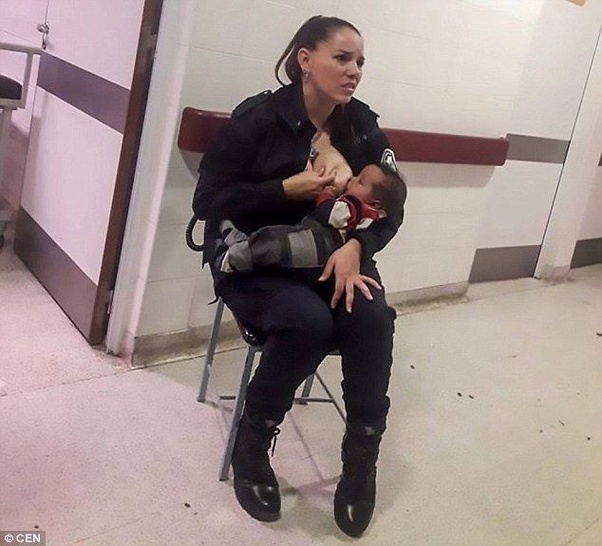
The now-famous photograph, captured in 2018 at a Buenos Aires children’s hospital, spread across social media within hours. It showed a uniformed officer feeding a malnourished infant whose mother couldn’t afford formula. The image sparked global admiration — and debate — about empathy, poverty, and the duties of those who serve.
Years later, the story of Celeste Ayala still resonates across communities from Argentina to Houston, where police departments and citizens alike cite her act as a model of compassion in uniform.
Who Is Celeste Ayala?
Celeste Ayala was serving as a police officer with the Buenos Aires Provincial Police when she responded to a routine call that would alter her life. Known among colleagues for her warmth and dedication, Ayala was also a mother of two.
On August 14, 2018, she and her partner escorted several neglected children to the Sor María Ludovica Children’s Hospital for medical evaluations. One of the infants, only a few months old, was weak, crying incessantly, and obviously hungry.
The Moment That Touched the World
Inside the hospital, staff informed Ayala that the baby’s mother couldn’t feed him and that he was malnourished. The facility was short-staffed, and the infant had been waiting for treatment.
Ayala later recalled thinking, “I could feel him trembling — he was so hungry. I asked if I could hold him, and they said yes.”
What happened next became an image that traveled around the globe: without hesitation, Ayala sat down, unbuttoned her shirt, and began to breastfeed the crying child. Her colleague, Marcos Heredia, quietly took a photo and posted it on Facebook, writing:
“I want to make public the great gesture of love you had today with that little baby. You did not care that you were in uniform. You acted as a true mother.”
The post went viral within hours, amassing tens of thousands of shares, headlines, and emotional comments praising her humanity.
The Reactions — Praise, Criticism, and Reflection
Social media largely celebrated Ayala’s compassion, calling her “the face of real policing.” Yet some critics questioned professional boundaries, arguing that her action was unconventional for an on-duty officer.
For Ayala, the debate missed the point. “It was a moment of pure instinct,” she told Argentine media. “I couldn’t let him go on crying. Sometimes uniforms hide hearts, but that day, I acted from mine.”
Her department agreed. Days later, Buenos Aires Police Chief Pablo Buján called her into his office — not for discipline, but to promote her to sergeant, commending her for compassion beyond duty.
“This is the kind of police we are proud of,” Buján said. “The police we want.”
A Symbol of Compassion Beyond Borders
The image of Officer Ayala quickly appeared in international news outlets from CNN and BBC to El País and The Guardian. In Houston, local media and police training forums discussed the act as an example of “community-oriented empathy.”
Many readers drew parallels between Ayala’s act and the growing movement in American law enforcement toward “humanity-based policing.” Community advocates in Detroit, Houston, and Los Angeles referenced her story in workshops promoting compassion in crisis intervention.
Poverty and Hunger: The Deeper Issue
The baby Ayala breastfed wasn’t just hungry — he was one of six children living in deep poverty. His mother reportedly told staff she had no money for food or formula.
Argentina’s 2018 economic crisis had pushed nearly one-third of families below the poverty line, creating conditions where infant malnutrition cases rose by 17 percent that year.
In Houston, similar challenges persist: according to the Houston Food Bank, one in five children remains food-insecure in 2025. Ayala’s act, though thousands of miles away, mirrors local realities — that compassion alone cannot solve systemic poverty, but it can remind society to act.
The Power of Empathy in Uniform
Police work often demands restraint, toughness, and composure under pressure. Acts of tenderness are rarely part of official training manuals. Yet Ayala’s moment of empathy demonstrated that compassion and professionalism are not opposites — they are partners in public service.
In interviews with police-training experts, including community liaisons in Detroit and Harris County, similar themes emerge:
-
Emotional intelligence improves de-escalation outcomes.
-
Officers who act with empathy often build stronger community trust.
-
Public perception of policing improves when humanity is visible.
Ayala’s act, simple but sincere, became a case study in this approach.
Lessons from Celeste Ayala’s Example
1. Humanity transcends uniform
Whether an officer, nurse, or civilian, the instinct to help defines shared humanity more than role or rank.
2. Compassion inspires change
Ayala’s promotion wasn’t just symbolic — it represented institutional recognition that empathy has operational value.
3. Poverty requires collective responsibility
Her action highlighted structural issues — hunger, inequality, and family support — that governments and communities must address together.
4. Role models matter
Ayala’s story continues to inspire both citizens and officers, reminding them that small acts of kindness ripple across continents.
Global Recognition and Continuing Impact
After the photo went viral, Ayala became a public figure. Mothers’ groups, humanitarian organizations, and children’s charities invited her to speak about empathy in service. She used her platform to advocate for family welfare programs and to destigmatize breastfeeding in public.
The Buenos Aires Police Department incorporated her story into its ethics training modules. Internationally, NGOs referenced her example in campaigns promoting women’s leadership in uniformed services.
By 2025, the photograph remains one of the most widely shared humanitarian images of the past decade — comparable to iconic moments like the “Napalm Girl” or the “Fallen Soldier’s Embrace,” but defined by hope rather than tragedy.
The Continuing Relevance of Ayala’s Story in 2025
Nearly seven years later, her message feels even more urgent. As economic challenges, migration, and public mistrust of institutions grow, stories of moral courage cut through cynicism.
In Houston, community policing initiatives like “Hearts and Badges” cite Ayala’s example in officer wellness training, reminding recruits that empathy is a strength, not a liability.
Detroit’s Neighborhood Unity Task Force also references similar acts of service — officers who’ve bought groceries for struggling families or repaired community playgrounds — as reflections of Ayala’s spirit at home.
Human Dignity and Everyday Heroes
At its heart, Ayala’s gesture wasn’t political; it was maternal, instinctive, and universal. The baby’s hunger, the mother’s helplessness, the officer’s quiet courage — all mirror daily realities faced by families worldwide.
When institutions act with compassion, they bridge the distance between authority and humanity.
That is the lasting lesson of Celeste Ayala: to serve doesn’t mean to stand apart — it means to stand with.
Key Statistics (2025 Context)
| Issue | Argentina | United States (Houston) | Source |
|---|---|---|---|
| Child Poverty Rate | 41% | 19% | UNICEF / US Census Bureau |
| Infant Malnutrition | 17% rise since 2018 | Approx. 9% food insecurity in infants | World Health Data |
| Police Trust Index (2025) | 62% | 58% | Ipsos Public Affairs |
| Female Police Representation | 15% | 13% | OECD Data |
Frequently Asked Questions
Who is Celeste Ayala?
A Buenos Aires police officer who became internationally recognized in 2018 after breastfeeding a starving baby while on duty at a hospital.
Why was her act significant?
Her spontaneous compassion challenged stereotypes about policing and highlighted the power of empathy in public service.
Did she face any repercussions?
No. She was promoted and publicly honored by her superiors for extraordinary humanity.
What can communities learn from this story?
That small acts of kindness can rebuild trust between institutions and the people they serve — locally and globally.