For years, Thomas Avery stored holiday decorations and old furniture in his attic without giving it much thought. The house was nearly a century old, and creaks and groans were just part of its charm. But this winter, he noticed something different.
A single plank in the attic floor was bowing upward.
At first he assumed the wood had swollen due to humidity. But as the days passed, the plank seemed to rise just a little more each week—almost as if pressure from underneath was pushing it upward.
Curiosity turned into concern when he set a heavy storage bin on the spot and noticed it wobbling. The floor beneath wasn’t just warped. It was hollow.
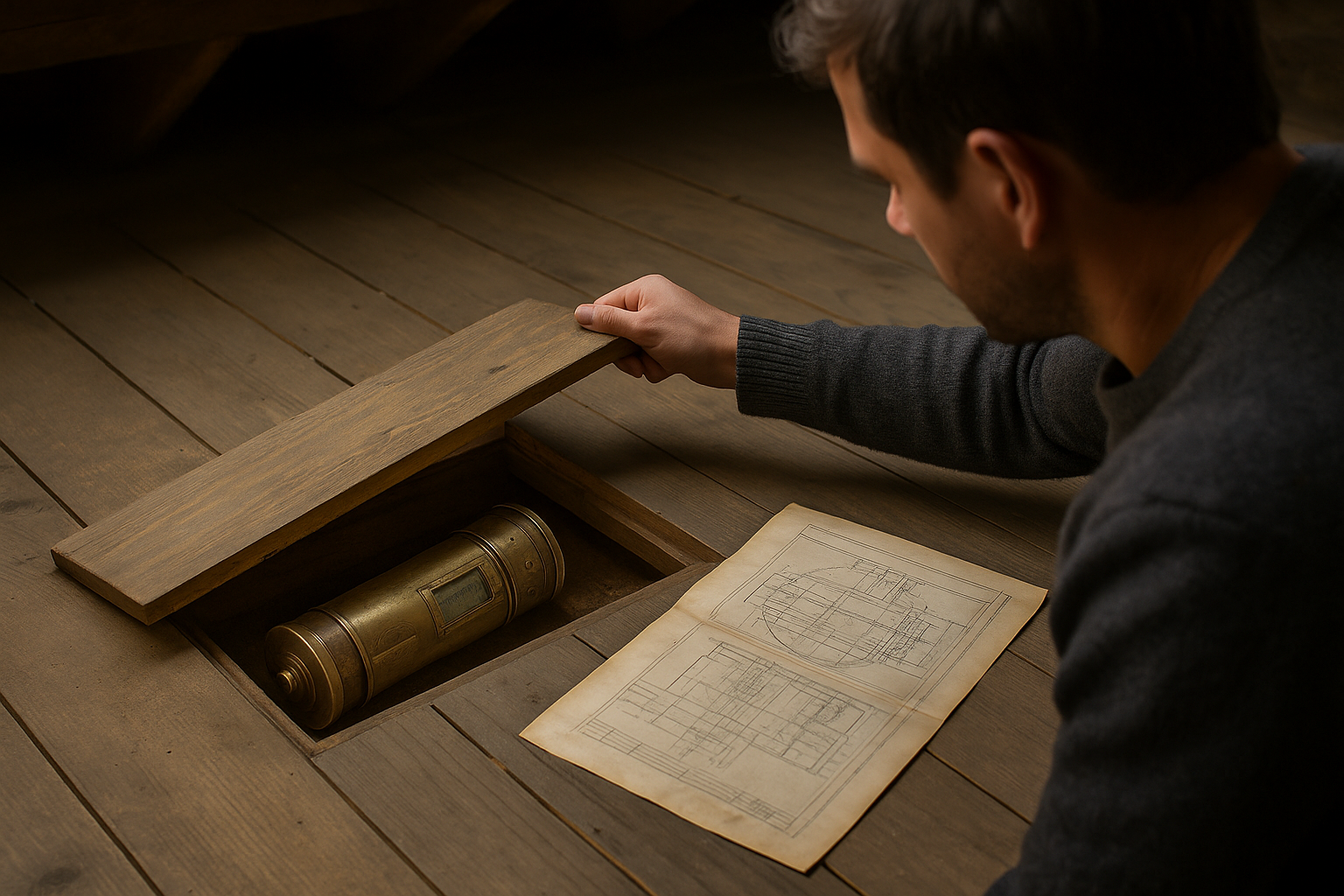
Thomas decided to investigate. He pried up the loose board, fully expecting to find a damaged beam or signs of pests. Instead, beneath the plank was a thin layer of dust covering a flat brass plate no bigger than a notebook.
The brass plate had a small handle.
His heart pounded as he lifted it.
Below the plate was a narrow compartment embedded deep into the attic’s subfloor. Inside lay a long, metal cylinder that looked more like a scientific instrument than anything belonging in a residential home. The cylinder had delicate engravings, numbered dials, and a small glass viewport.
Next to it lay a stack of yellowed schematics, tightly rolled and secured with twine.
When Thomas retrieved the papers and unrolled them, he realized he was holding detailed blueprints of experimental architectural systems—specifically, early attempts at temperature-regulating airflow designs from the 1940s. The original homeowner had been a structural engineer involved in wartime research, and according to the notes, this prototype device was one of his personal experiments.
The cylinder, as the documents explained, was an early passive ventilation regulator meant to stabilize temperatures inside wooden homes. It used expanding metal coils and a weighted diaphragm to automatically redirect airflow through attic vents—decades before similar technology became mainstream.
The mechanism had been installed quietly beneath the floor as a test. Over time, the metal coils inside expanded from age and temperature fluctuations, pushing the attic plank upward and revealing the device’s long-hidden location.
When experts examined the find, they declared it one of the earliest surviving examples of residential climate-control engineering. Several of the concepts in the notes matched techniques still used today.
Thomas chose to preserve the device in a glass case he installed in the attic, leaving the floorboard slightly raised to mark the place where the house had quietly held onto a piece of forgotten engineering history.