


Basketball never forgets. Every fan remembers the heartbreaks — the trades that didn’t work, the strategies that backfired, the series that broke a city’s heart. For the Houston Rockets, the 2020 experiment in “microball” became one of those memories: audacious, thrilling, and ultimately disastrous.
Now, half a decade later, Houston’s roster has swung to the opposite extreme. The Rockets, once mocked for being undersized, are now built like a wall of muscle and wingspan. And the irony is delicious.
If they can dominate the boards and bully their way deep into the 2026 playoffs, they’ll do more than just win games. They’ll avenge an era — proving that the lessons of that small-ball fiasco have finally come full circle.
That’s what makes this season different. This is about redemption, identity, and basketball’s strange sense of symmetry.
Background & Context: The Microball Experiment That Went Up in Smoke
In the winter of 2020, Houston made a move that sent shockwaves across the league: they traded Clint Capela — a 6’10” rim-running center in his prime — to fully commit to a revolutionary idea. They would play without a traditional big man.
At first, it looked like genius. P.J. Tucker, a 6’5” bulldog, started at center. James Harden and Russell Westbrook got open lanes, spacing improved, and the Rockets caught fire. They stretched defenses thin, rained threes, and looked like basketball’s next evolution.
Then came the Lakers.
In the 2020 playoffs, Houston’s microball dream met a 7-foot reality. The Los Angeles frontcourt — Anthony Davis, Dwight Howard, LeBron James — obliterated Houston on the glass. The Lakers grabbed more than a quarter of their offensive rebounds, suffocating Houston’s possessions. The Rockets’ speed couldn’t compensate for their size disadvantage.
It wasn’t just a loss; it was a reckoning. The league took note. You can’t out-scheme physics.
The Core Story: From Tiny to Towering
A Franchise Reborn
Fast-forward to 2025. Houston’s roster looks like the inverse of that 2020 team. Their offensive rebounding rate in 2024–25 — 36.3% — was the highest in NBA history. That’s not a typo. The team that once built its identity on shooting over size now dominates by swallowing misses whole.
And this season, they’re even bigger.
The Depth Chart That Dwarfs the League
Consider their likely rotation:
-
C: Alperen Sengun – an offensive savant with the footwork of a guard and the mass of an ox.
-
PF: Jabari Smith Jr. – long, agile, and finally stepping into his confidence.
-
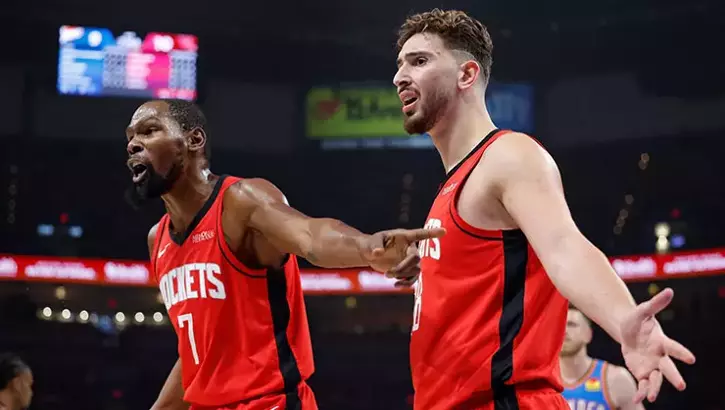
SF: Kevin Durant – the 6’11” hybrid scorer who can play anywhere.
-
SG: Tari Eason – a wing built like a linebacker with a defensive motor that doesn’t quit.
-
PG: Amen Thompson – a 6’7” playmaker who breaks every definition of a “guard.”
That’s a lineup where the shortest player is taller than most shooting guards.
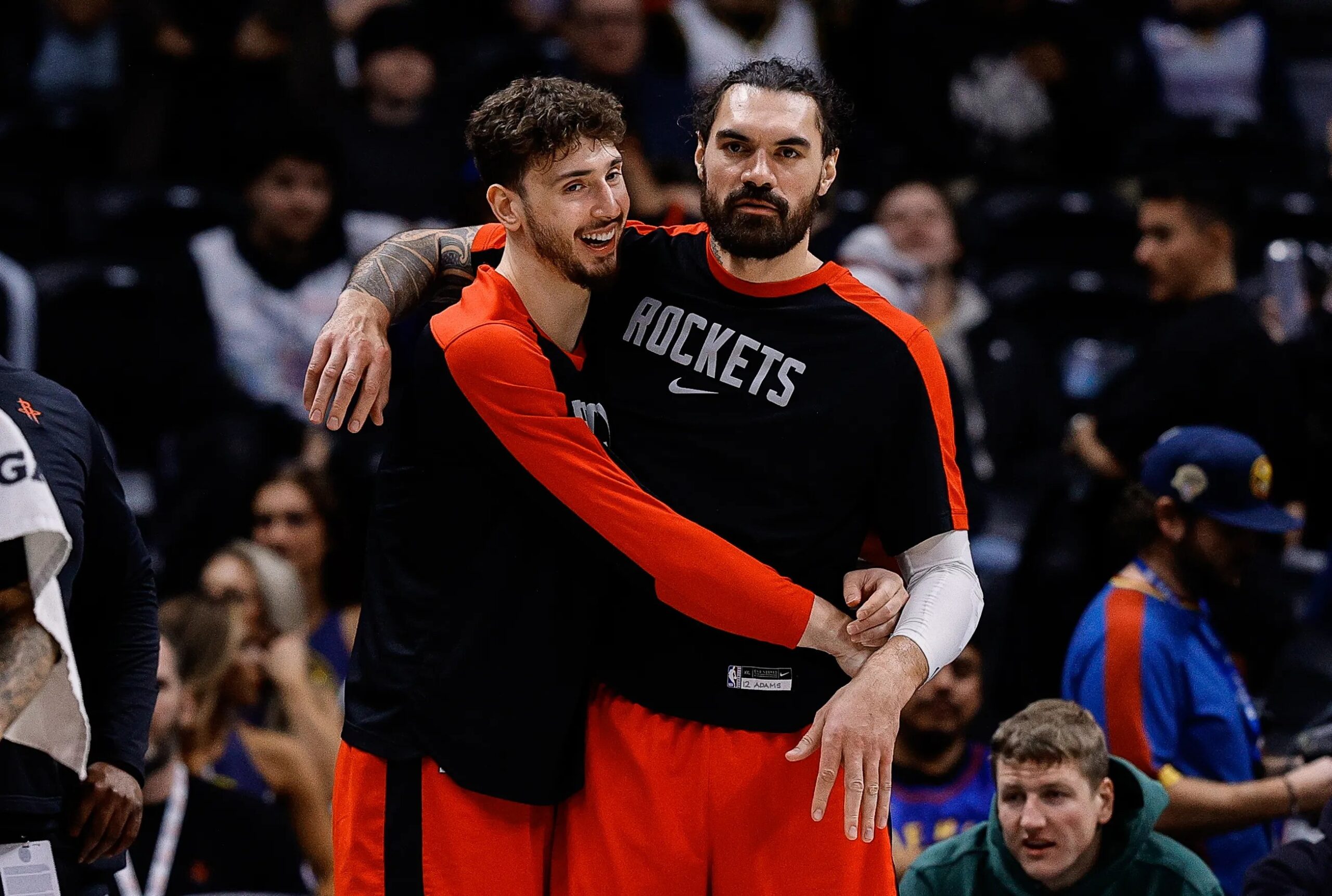
Head coach Ime Udoka has even toyed with ultra-big configurations featuring Steven Adams and Clint Capela together — a twin-tower look that evokes late-90s basketball more than the analytics-driven 2020s.
The Philosophy of Size
This isn’t just about aesthetics. It’s a statement. The Rockets learned the hard way that innovation means nothing if it ignores fundamentals. Height and strength still matter. Rebounding is still a possession battle. The rim still decides championships.
And so the Rockets have evolved — not by rejecting modern basketball, but by merging it with primal dominance.
Analysis & Implications: The Logic of Poetic Justice
A Philosophical Turnaround
In 2020, Houston tried to out-think basketball. In 2025, they’re trying to out-muscle it.
Their rebounding dominance is no accident. Udoka’s schemes emphasize vertical spacing as much as horizontal. Instead of chasing pure pace and threes, the Rockets now hunt second chances. They crash the boards like it’s religion. Every missed shot is a fresh opportunity — and statistically, that math adds up.
There’s something beautifully ironic here. The same franchise that once declared centers obsolete is now hoarding them. The pendulum hasn’t just swung — it’s snapped the clock.
A Cultural Correction
For Houston fans, the emotional resonance runs deeper than strategy. Microball wasn’t just a failure on the court; it became symbolic of an era of chaos — from front-office overreach to Harden’s disillusionment.
Reclaiming dominance through size feels like reclaiming dignity. It’s poetic justice because it doesn’t erase the past — it redeems it.
The Lingering Caveat: Guard Play
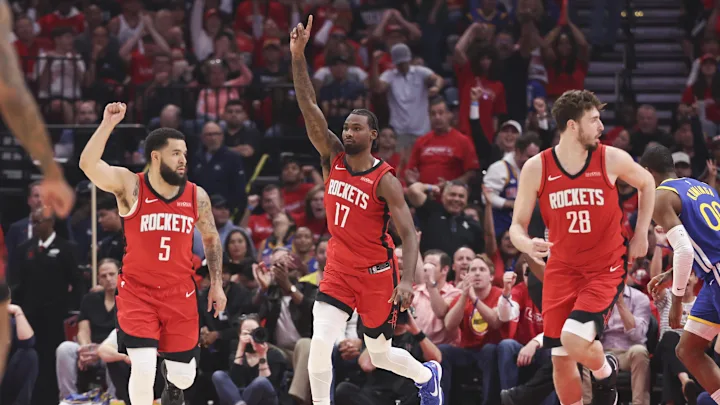
Of course, poetic justice doesn’t win championships on sentiment alone. The Rockets’ glaring weakness lies in the backcourt. With Fred VanVleet injured, ball-handling duties fall to young Reed Sheppard and journeyman Aaron Holiday. That’s thin depth for a long season.
Still, the Rockets’ structure may protect them. Amen Thompson, a 6’7” blur, can orchestrate the offense by committee. Durant and Sengun can initiate half-court sets. And in a world where positionless basketball reigns, maybe “guard” is an outdated concept anyway.
The Rockets don’t need traditional ball-dominant guards — they just need to keep leveraging size, switching, and relentless rebounding to neutralize opponents.
Local & Human Impact: The Redemption of a Fan Base
Houston has always prided itself on basketball innovation. The city birthed analytics-driven offense under Daryl Morey, and the “Moreyball” philosophy forever changed how teams value efficiency.
But innovation cuts both ways. When the microball experiment collapsed, fans felt mocked — not just by rivals, but by fate. The narrative was cruel: Houston dared to be different and paid for it.
Now, fans are watching something that feels like restoration. This team plays with physical edge and emotional maturity. The swagger is back, but it’s tempered by humility. The Rockets have stopped trying to outsmart basketball and started trying to embody it again.
At Toyota Center, the energy has shifted. Every offensive rebound brings the crowd to its feet — not just because it leads to points, but because it represents revenge.
Broader Trends & Lessons
The League’s Cyclical Nature
The NBA is a pendulum. For every small-ball movement, there’s a counter-wave of size. The Warriors revolutionized the game with shooting and space, but even they needed Kevon Looney to grab 20 boards a night during playoff runs.
Now, as more teams chase length, Houston sits ahead of the curve. Their roster construction echoes what Denver did with Nikola Jokić — emphasizing physical presence without sacrificing skill.
Rebounding as the Next Efficiency Frontier
Advanced analytics now highlight rebounding opportunities created — not just raw totals. The Rockets dominate these metrics. Their extra possessions offset inconsistent shooting. If they sustain a historic offensive rebounding rate, they could force teams to adjust defensively in unprecedented ways.
A Cautionary Note
History warns that extremes eventually self-correct. If Houston leans too far into brute strength, spacing could suffer. The key will be finding harmony — blending the lessons of 2020’s small ball with the muscle of 2026’s giant ball.
Still, even if this balance takes time, Houston’s direction feels right. They’ve rediscovered the simple, ancient truth: basketball belongs to those who control the paint.
What Happens Next: The Road to Validation
If the Rockets’ new experiment succeeds — if they bully their way into contention — the narrative will be irresistible.
Imagine the headlines: Houston, once destroyed by size, now destroys with it.
The symbolism writes itself. The microball critics will have to admit that failure wasn’t in the ambition — it was in the imbalance. You can innovate, but you can’t ignore the rim.
Udoka’s next challenge will be refining chemistry. Durant brings leadership and star power but must coexist with a rising generation of talent. Sengun, still the franchise’s fulcrum, needs touches to thrive. Amen Thompson must learn to dictate pace while defending elite guards.
If those pieces click, Houston won’t just win — they’ll rewrite their legacy.
Conclusion: The Poetry of the Bounce Back
Poetic justice rarely arrives in sports. Usually, heartbreak just lingers, unavenged. But every once in a while, the ball bounces back.
The 2025-26 Houston Rockets are standing on that bounce.
They’ve built the tallest, strongest, most physically dominant roster in the league — not out of vanity, but out of experience. They’ve lived through the humiliation of being too small, too clever for their own good. Now, they’re building something elemental.
If they succeed, it won’t just be a championship. It’ll be the closing chapter to one of basketball’s strangest odysseys — a journey from overthinking the game to rediscovering its most primal truth.
Size still matters. Rebounding still wins. And sometimes, the only way to make peace with your past is to tower over it.
FAQ
Why is this season seen as “poetic justice” for Houston?
Because the Rockets’ current dominance in size and rebounding directly counters the 2020 microball strategy that failed spectacularly.
Who are the key players driving this turnaround?
Alperen Sengun, Jabari Smith Jr., Kevin Durant, Tari Eason, Amen Thompson, and Steven Adams — a lineup built to overwhelm physically.
Can the Rockets win without elite guard play?
Possibly. Their collective playmaking and size may offset the lack of traditional ball-handlers.
How does this reflect broader NBA trends?
It signals a shift away from extreme small-ball toward hybrid systems that value both size and spacing.