

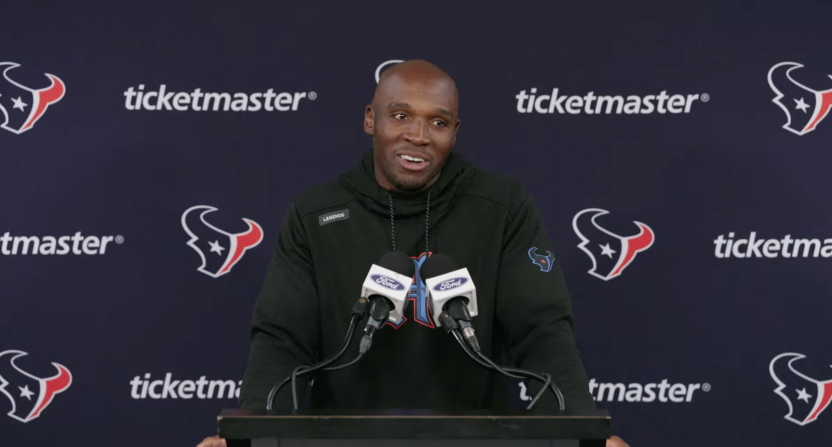
Houston Texans head coach DeMeco Ryans used his Monday press conference to address the portrayal of his team, arguing that media coverage disproportionately focuses on negatives despite his squad’s rapid turnaround. The remarks come at a pivotal moment for a franchise that has ascended from 3–13–1 to back-to-back playoff appearances.
“If You Feed Off the Negative…”
Asked about how his team handles public scrutiny, Ryans cut to the point:
“Here … you can see there’s a lot of negative talk about us. We get it. I hear people trying to give it to me all the time. But it really doesn’t matter.”
He added, “Everybody wants to write a hot story, and most of the time it’s negative stuff that people want to talk about. Nobody wants to talk about the positive stuff that happens.”
Ryans continued, “If you feed off of that and you’re riding the pendulum of ‘Oh, we’re great because we won. Oh, we suck because we lost.’ … That’s our business; I get it. But that’s the nature of it. We keep moving forward.”
When pressed by reporters who pointed to numerous positive stories about the Texans’ resurgence, Ryans responded simply: “You guys good?”—and moved on.
A Perceived Disconnect
Ryans’ frustration highlights a broader tension. While the Texans have been celebrated in recent seasons for their dramatic turnaround, the coach feels the narrative remains anchored in past struggles or episodic setbacks. He challenged media professionals by saying: “You guys must be the negative ones with the negative stuff,” suggesting that the tone of coverage is self-reinforcing.
Several local media members pushed back, clarifying that their outlets have covered Houston’s improved roster, young star quarterback C. J. Stroud, and coaching staff extensively. They argue that criticism arises organically—even when the team performs well—because analysis demands context, not just praise.
Why This Matters for Houston
Ryans’ comments matter for several reasons:
-
Team psychology: A head coach publicly expressing frustration with media coverage may reflect deeper concerns about narrative control or morale management within a young team.
-
Media relations: The exchange signals a shift in how the Texans’ staff may engage with reporters going forward—either with increased defensiveness or tighter message discipline.
-
Franchise identity: Houston’s recent success has elevated expectations. Yet Ryans appears concerned that the team’s progress is still defined by past labels rather than current performance.
Context Behind the Complaints
Since obtaining playoff berths, the Texans have garnered positive attention, but Ryans believes those successes don’t translate into consistent momentum in the media. His contention is that meaningful achievements rarely get the same spotlight as failures or controversies.
Critics note that a coach who truly viewed media coverage as irrelevant might avoid addressing it altogether. Ryans’ decision to highlight it repeatedly suggests the issue has penetrated deeper—perhaps touching on internal accountability or external expectations.
What to Watch Next
-
Media engagement strategy: Will the Texans alter their press-conference tone, perhaps providing fewer comments or more tightly controlled updates?
-
Performance response: The next few games will test whether the team lets external narrative pressures impact on-field execution or remains insulated.
-
Narrative shift: If Houston continues winning, the media tone may naturally evolve. Ryans’ real test will be whether he embraces and shapes that shift.
Final Thought
DeMeco Ryans’ blunt critique of how the media covers the Texans is less about optics and more about narrative ownership. It reflects the delicate balance between a franchise writing a new chapter and the public’s appetite for stories rooted in struggle. For Houston, the challenge now is not only winning games, but also rewriting how it’s written about.