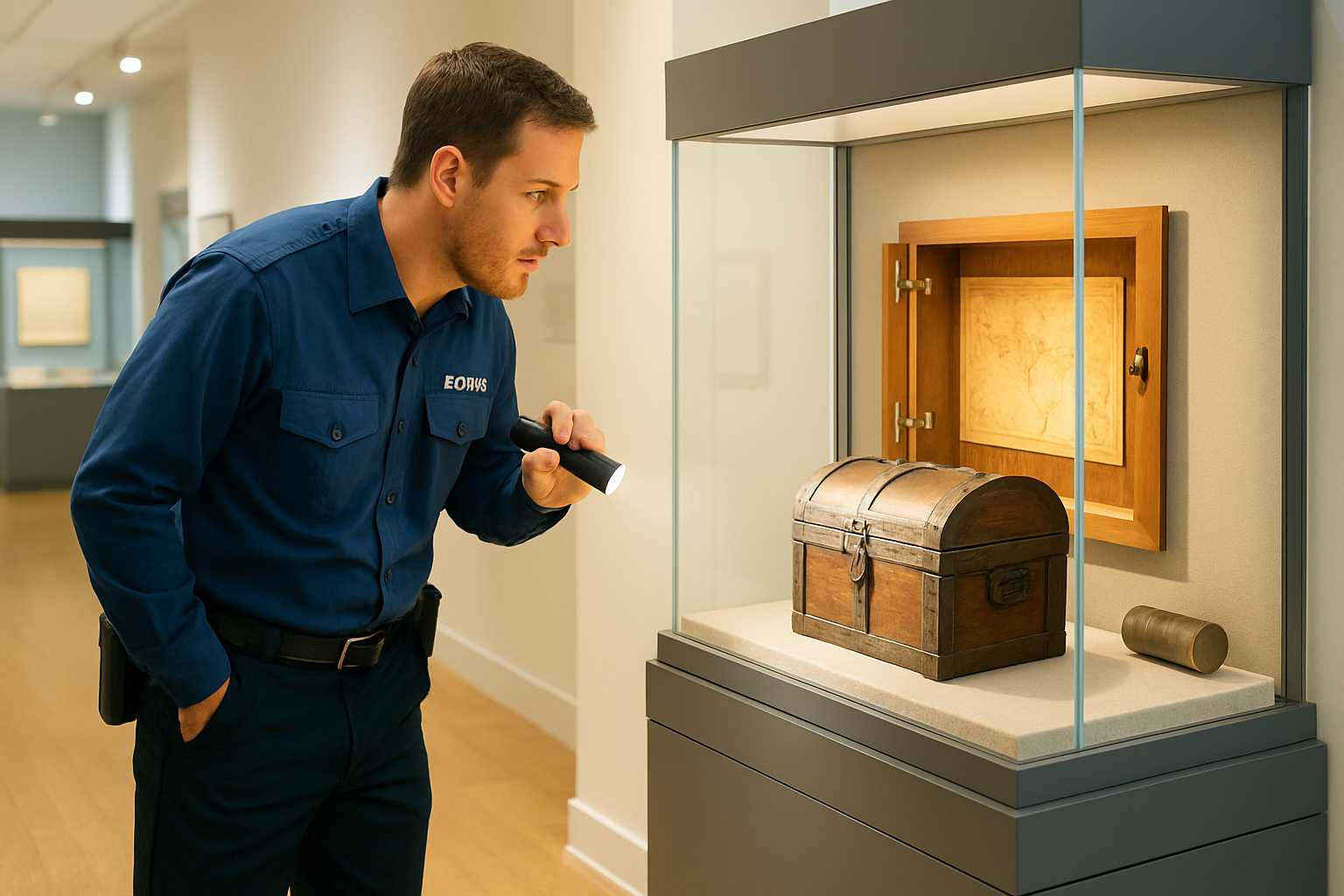
Ethan Carver had worked the night shift at the Westbridge Museum for nearly a decade. The building was old, creaky, and full of history—exactly the type of place where unusual noises never truly surprised anyone.
But this time was different.
Just past 2 a.m., while making his routine patrol through the Hall of Antiquities, Ethan heard it: a faint tapping. Slow, deliberate, rhythmic. It was coming from one of the sealed display cases holding a centuries-old wooden chest excavated from a shipwreck.
He paused, listening.
Three taps.
Silence.
Three more taps.
The pattern repeated with eerie precision.
Ethan scanned the room. No movement, no drafts, no mechanical system that could be causing it. Museum cases were climate-controlled and soundproofed — nothing inside should have been capable of making noise.
Still, the tapping continued.
Concerned about possible damage to the artifact, Ethan radioed his supervisor, who advised him to check for structural issues. Ethan crouched beside the case and shined his flashlight along the edges.
That’s when he noticed something he had never seen before.
Behind the chest, partially concealed by the angle of the spotlight, was a small wooden panel built into the back of the display case wall — a panel that didn’t match any blueprints.
The tapping grew slightly louder when he pressed his ear against it.
Knowing he couldn’t ignore it, Ethan unlocked the outer glass enclosure (procedures required immediate inspection if an artifact seemed compromised). He carefully removed the chest from the platform and inspected the mysterious panel.
It had a recessed finger groove.
He pulled it open.
Behind the panel was a narrow cavity containing a rolled canvas sealed in wax and a metal tube no larger than a flashlight. The tube gave off a faint vibration — the source of the tapping.
Inside the tube was a mechanical device made of gears, springs, and a tensioned strip of lacquered wood. It appeared to be a centuries-old maritime signaling device that automatically tapped at set intervals. The mechanism had likely reactivated due to shifts in the museum’s humidity controls.
The canvas, once unrolled, revealed something even more astonishing: a hand-drawn map of the shipwreck’s original cargo layout — a map historians had long believed lost.
It included markings hinting at sections of the wreck never fully explored.
Experts were stunned. The chest had already been cataloged and studied extensively, yet no one knew it contained a hidden compartment with such historically significant materials.
The tapping had been the only clue.
Ethan’s report earned him public recognition from the museum board. The discovery not only added a new chapter to the story of the shipwreck but also opened possibilities for renewed expeditions.
Today, the restored signaling device sits in its own display, still tapping softly every hour — a reminder that history sometimes speaks, even when no one expects it to.