The ocean research vessel Marlin’s Echo had been charting temperature data along a quiet stretch of the North Atlantic for nearly a week. Everything had been routine—steady readings, predictable currents, nothing unusual.
Until the spike.
At exactly 2:14 pm, the ship’s thermal sensors detected a narrow column of warm water rising from the seafloor. Not a gradual shift, but an abrupt plume—10 degrees warmer than the surrounding ocean. The anomaly was so sharp that the ship’s onboard system flagged it as a malfunction.
But the sensors were working perfectly.
Intrigued, the crew launched a submersible drone to investigate. The footage returned something unexpected: the seafloor at the anomaly site was fractured in a clean, circular shape, unlike any natural formation the team had seen.
The drone’s lights swept across the area.
Something metallic glinted back.
Divers were deployed.
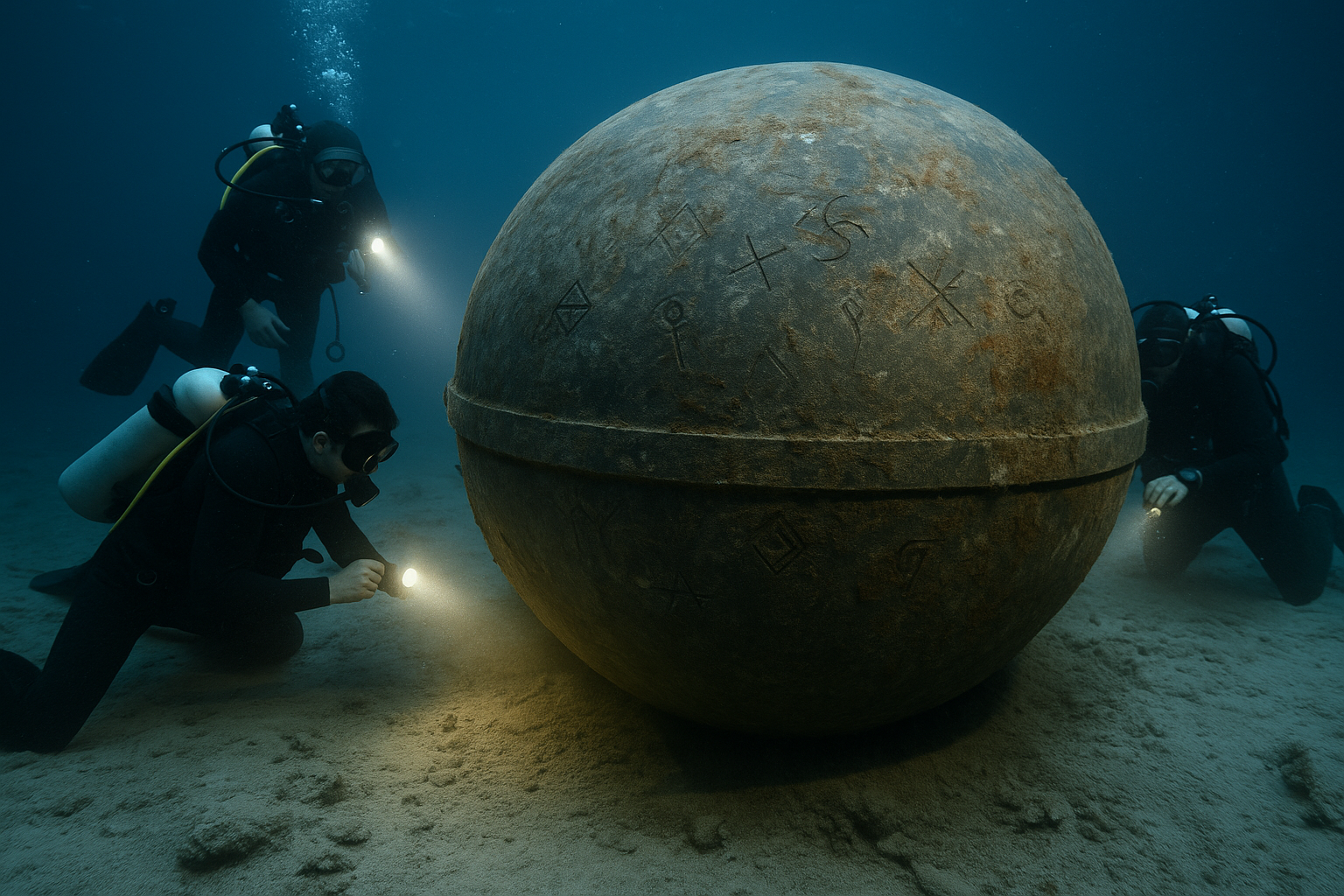
At 60 meters down, lying partially buried in sediment, was a massive iron sphere—roughly the size of a small car. Its surface was etched with symbols, weathered but still visible beneath layers of marine growth. A narrow seam circled the sphere like an equator.
The temperature spike originated directly beneath it.
When the divers brushed away sediment, they discovered something even stranger: the sphere was slightly vibrating. Not enough to feel through a glove, but enough to disturb the water around it in rhythmic waves.
The object was lifted aboard under strict protocol.
On deck, marine archaeologists examined the markings. Initial assessments suggested a design far older than any known maritime culture. No records existed of anything this size, shape, or material appearing in oceanic trade routes.
Later that evening, while the crew ran scans on the object, the seam around its center emitted a low, steady hum.
Then it opened.
The sphere separated into two perfect halves, revealing an inner chamber lined with a honeycomb of crystalline structures. Inside the chamber was a preserved map—etched onto a piece of metal as thin as parchment. The map bore coastlines and landmasses no longer matching modern geography, including a vast land bridge long believed hypothetical.
According to the researchers, the sphere was likely a navigational archive created by an ancient seafaring civilization whose knowledge of the oceans predated existing historical timelines.
The heat spike, they theorized, occurred when geological activity shifted the sediment covering the sphere, activating a dormant mechanism designed to make the object rise to the surface.
The Marlin’s Echo returned to shore under full media blackout, but whispers spread among the scientific community about “the sphere that corrected world maps.”
Today, the object is kept in a controlled facility. Its origin, purpose, and creators remain unknown.
But one thing is certain:
The ocean had been hiding a memory of the world that humans had long forgotten.